Nick Wright
Ernest Rutherford Fellow

Menu:
Cygnus OB2
Cygnus OB2 is one of the most massive young clusters of stars in our Galaxy, and at a distance of only 1.40 kpc is also one of the closest. It's proximity makes it one of the best places to study star formation on the largest scales and also determine how star formation varies in the vicinity of a large number of massive stars.
From a near-IR study, Knodlseder (2000) estimated the total number of OB stars in the region to be ~2600, with 120 O-type stars. Hanson (2003) has argued that this estimate is overestimated by the inclusion of non-members from the surrounding region, while Comeron et al. (2008) identified an extended halo of early-type stars that they suggested originated from a field population across the Cygnus region from previous generations of star formation. Such a suggestion supports other observations (Drew et al. 2008) of an older generation of star formation in the region, in addition to the recent burst that created the many young O-type stars.
We are studying Cygnus OB2 using observations from the Chandra X-ray observatory, identifying the young pre-MS members of the association through their elevated X-ray activity compared to the large foreground and background populations in the Galactic plane.
The First Observations (2008-2010)
In 2008-9 I used two archival Chandra observations of Cygnus OB2, extracting and characterizing X-ray point sources and combining these with optical and near-IR photometry from recent Galactic Plane surveys such as IPHAS and UKIDSS, which also allowed us to remove background contaminants. You can read about our full catalog of 1696 X-ray point sources in Wright & Drake (2009) and download the data here.These data were used to study the integrated properties of the young stellar population. Using near-IR photometry we estimated the age of the association to vary between 3.5 and 5.25 Myrs in the central and outer regions respectively. This difference is consistent with previous findings that the outer regions may contain an older population. We also identified low fractions of stars with evidence for circumstellar disks (via their near-IR excesses) of 6-8%, lower than typically found in similarly aged clusters (20-40%). This could suggest that the circumstellar disks are being prematurely eroded by the presence of the large number of massive stars in the cluster.
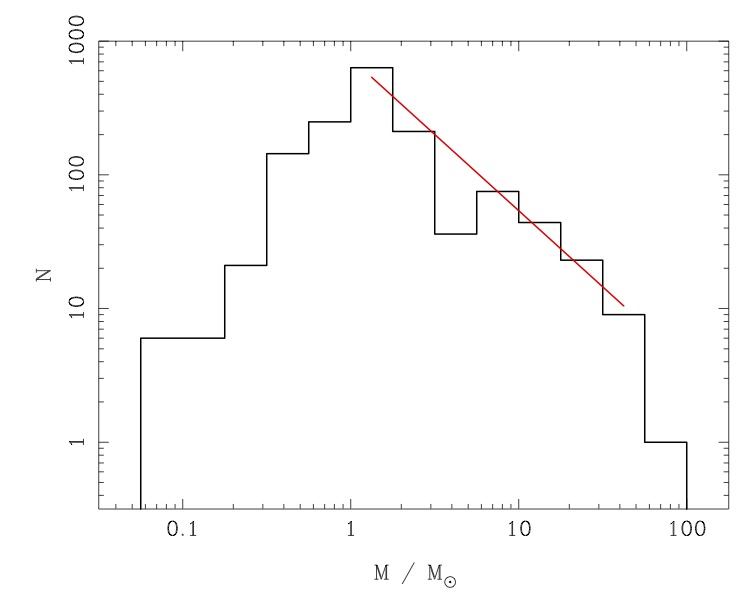
Stellar masses were estimated for all stars using near-IR photometry and allowed mass functions to be compiled (see right). The mass function was found to be broadly Salpeter-like with a slope of -1.09, but steepened at high masses. We suggest that this represents an 'age-steepening' of the mass function as the highest-mass stars in the association have evolved to the end-states, thereby depleting the number of stars in the highest-mass bins of the mass function. As the deepest and most complete survey of young stars in Cygnus OB2 to date this result corrects the previously estimated steep mass function that can now clearly be seen to have placed too much weight on the most massive stars in the association. To read about all of this work please see Wright et al. (2010). |
|
The Cygnus OB2 Chandra Legacy Survey
In 2009 we proposed to extend these limited observations to a wider area and to a greater depth so that the entire association could be studied in considerable detail. The objective of this was not only to map out this massive association and determine its true size and spatial extent, but also to study the early evolution of young proto-planetary disks in the harsh environment of such a massive young cluster.
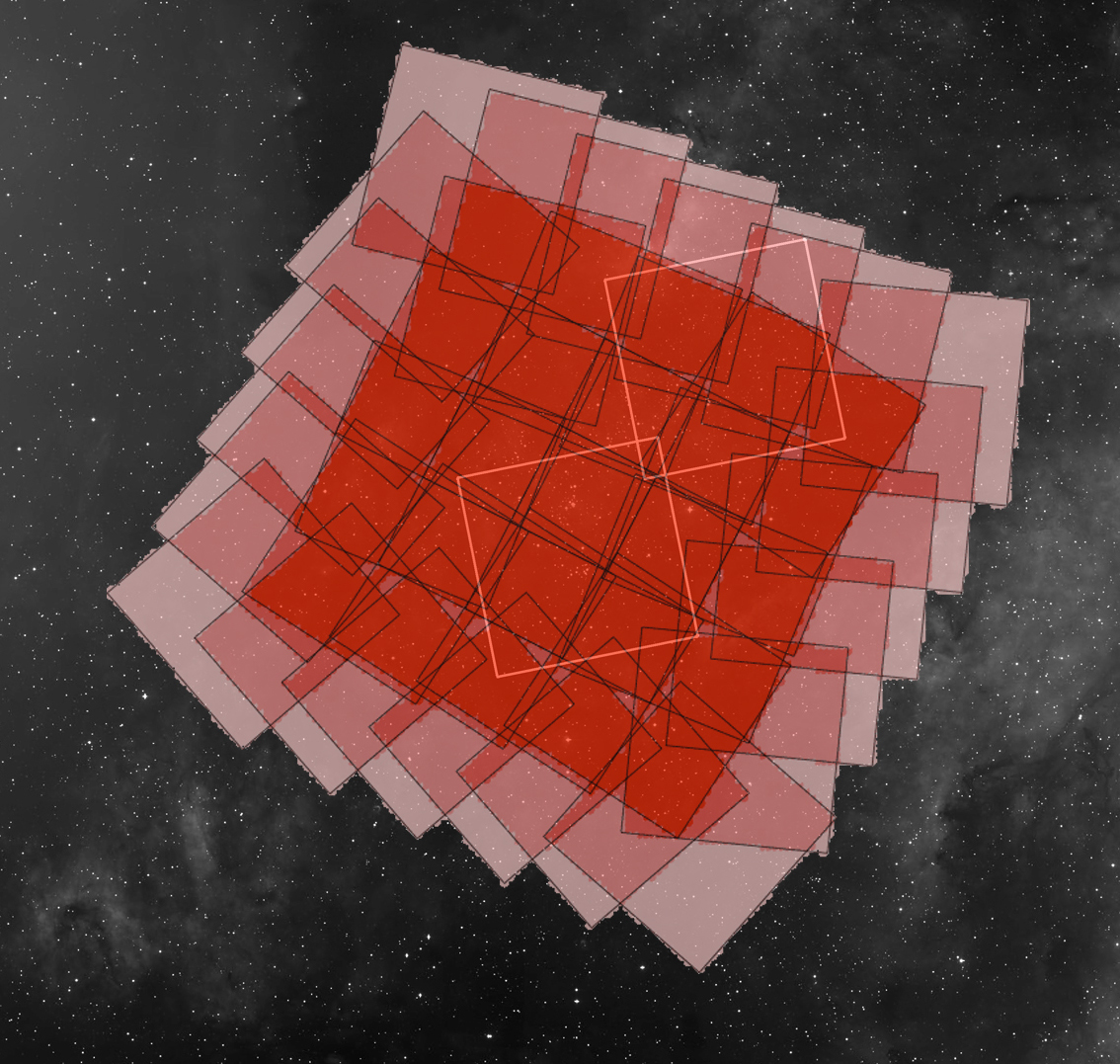
Observations were performed in early 2010, comprising a total of 36 pointings with Chandra's ACIS-I imager arranged in a grid of 6 X 6 to provide a complete survey area of 1 square degree and reaching a total depth of 120 ks (see right). This is a factor of 6 larger than the original observations (discussed above) and with exposures that now reached as much as a factor of 3 deeper. |
|
The survey has detected approximately 10,000 X-ray sources, the vast majority of which are thought to be members of Cygnus OB2 and are also detected at optical, near- and mid-IR wavelengths. This extensive multi-wavelength catalog is providing an unparalleled view of this massive and important star factory. In addition we are in the process of obtaining spectra for 3000 of these sources that will allow us to derive accurate spectral types, stellar masses, and radial velocities. These radial velocities will be combined with photometric proper motions to provide the first 3-dimensional kinematic study of a massive star cluster. For a preview of results from the Chandra Cygnus OB2 Legacy Survey see Wright (2011).