 |
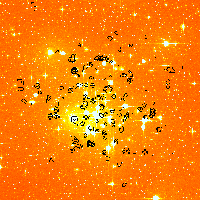
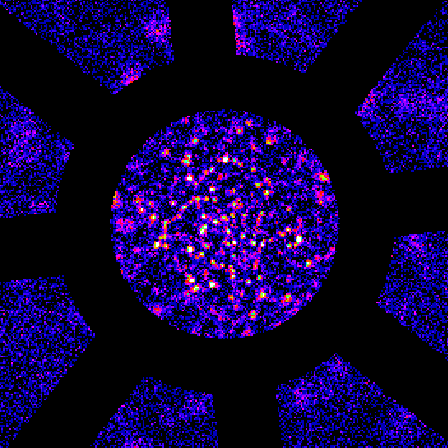
As an example, consider the young open cluster NGC 2516, which has
an age of only 150 million years. The picture at the top of the page
shows a 55 ks exposure with the ROSAT X-ray telescope
position sensitive proportional counter (PSPC). To the left is a
contour overlay of the X-ray emission on top of an optical image of the
cluster. The majority of X-ray sources are coincident with faint
low-mass stars.
There are only a few coincidences between the
X-ray sources and the optically bright sources. This is because the
bright stars of the cluster are more massive and have no convection
zone and thus no internal dynamo. In fact we believe that where there
is an X-ray source coincident with a bright star, it is because it is
in a close binary with a fainter, low-mass star, that has a convection
zone and a hot corona. |

 rdj@astro.keele.ac.uk