 |
Active Stars
|
The Dynamo
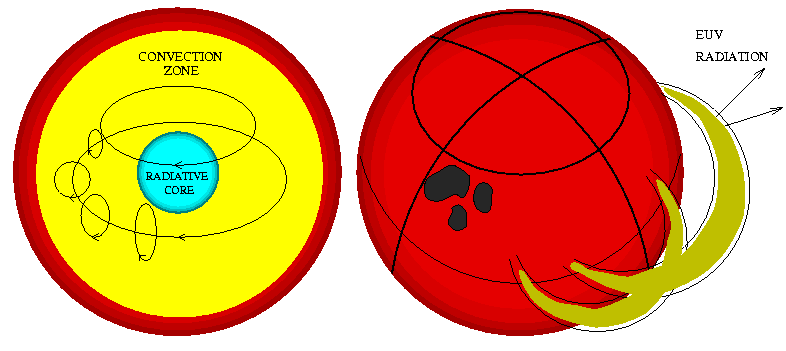
Cool stars with convective envelopes generate magnetic fields via
an internal dynamo mechanism. Convective motions and differential
rotation "wind up" the magnetic field lines.
The magnetic field emerges from the
stellar surface, traps and heats a tenuous coronal plasma to millions
of degrees, which then emits X-ray
and extreme ultra-violet (EUV)
radiation (see picture).
Other manifestations of this magnetic activity include huge
starspots, much larger than there counterparts on the sun, flares and
chromospheric emission. Because of the strong influence of rotation on
the dynamo optical observations have shown
that EUV-strong cool stars are either...
 Rapidly rotating stars in close binary systems.
- Tidal locking of the components ensures that they are rapidly
rotating. We find typical periods for these stars of between 0.5 and 5
days.
- Young,
single rapidly rotating stars.
- We believe that these stars are younger than 100 million years,
mainly because they have strong photospheric lithium
signatures. Angular momentum loss mechanisms have had insufficient time
to spin these stars down. There is some evidence that they form a
kinematic association.
-
Or stars that have been spun up by accretion in some way.
- There are some examples of rapidly rotating cool stars accompanied
by hot white dwarfs in wide binary systems. A model has been developed
which explains the cool star rotation through accretion of the massive
slow wind from the asymptotic giant branch progenitor of the white
dwarf.
References and preprints for some papers on these topics can be found
in my publications list .
Further active star links
-
Armagh Observatory (including
preprints).
-
Osservatorio Astronomico di
Palermo (including preprints).
Rob Jeffries  rdj@astro.keele.ac.uk
Department of Physics
University of Keele
Keele
Staffordshire ST5 5BG, UK
2nd December 1996