The Determination of Teff and log g for B to G stars
B. Smalley
Department of Physics, Keele University, Staffordshire, ST5 5BG,
United Kingdom
Abstract
A review of the methods for determining the Teff and log g
for B to G type stars is presented. The four most-commonly used methods
— photometry, spectrophotometry, hydrogen-line profiles and the
Infrared Flux Method — are discussed. The Teff – log g
diagram is also discussed, along with the use of fundamental stars in the
calibration of model atmosphere fluxes and colours.
Introduction
The stellar atmospheric parameters of effective temperature (Teff) and surface gravity (log g) are of fundamental astrophysical
importance. They are the prerequisites to any detailed abundance
analysis. As well as defining the physical conditions in the stellar
atmosphere, the atmospheric parameters are directly related to the
physical properties of the star; mass (M), radius (R) and luminosity
(L).
Model atmospheres are the analytical link between the physical properties
of the star (M, R and L) and the observed flux distribution and
spectral line profiles. These observations can be used to obtain values
for the atmospheric parameters, assuming of course that the models used
are adequate and appropriate. The values of Teff and log g
obtained must necessarily be consistent with the actual values of M,
R and L. Unfortunately, the physical properties of stars are not
generally directly ascertainable, except in the cases of a few very
bright stars and certain binary systems. We have to rely on model
atmosphere analyses of spectra in order to deduce the atmospheric
parameters.
We need to be confident in the atmospheric parameters before we start any
detailed analyses. This is especially important when comparing chemically
peculiar stars to normal ones. Take, for example, the recent
disagreements over the atmospheric parameters of the metallic-lined (Am)
stars: Smalley & Dworetsky (1993) found that the large systematic
differences between the results of Lane & Lester (1984) and Dworetsky &
Moon (1986) were due to metallicity effects. Hence, it is very important
to ensure that the atmospheric parameters used are free from any
systematic errors. These can be introduced, for example, by differences
in atmospheric chemical composition, rotational broadening, interstellar
reddening, the presence of a binary companion, etc.
The four most widely used methods for determining Teff and log g are now discussed.
Photometry
The intensity of stellar flux varies as a function of wavelength and
these variations are linked to temperature, surface gravity and chemical
composition. A measurement of stellar flux at several wavelengths can be
used to determine such parameters. Ideally, continuous spectrophotometric
wavelength coverage through a narrow bandpass would be the preferred
observations, but this is time consuming and generally only possible for
relatively bright stars.
Wide and intermediate band photometric systems have been developed to
describe the shape of stellar flux distributions via magnitude (colour)
differences. Since they use wide bandpasses observations can be obtained
in a fraction of the time required by spectrophotometry and can be
extended to much fainter magnitudes. The use of standardized filter sets
allows for the quantitative analysis of stars over a wide magnitude
range.

Figure 1: Examples of uvbyβ calibrations. The solid lines are the
grids of Smalley & Dworetsky (1994) and the dotted lines those of Moon
& Dworetsky (1985).
By carefully designing the filter bandpasses that define a photometric
system, colour indices can be obtained that are particularly sensitive to
one or more of the stellar parameters. Indeed, photometric surveys of
faint stars are used to identify anomalous stars which warrant much
closer spectroscopic investigation. Photometric colour indices, once
calibrated with model atmospheres, can be used to determine atmospheric
parameters. Three photometric systems are in general use:
- The most widely used photometric system is the UBV system,
developed by Johnson & Morgan (1953). The calibrations by Buser &
Kurucz (1978, 1992) are worth noting. However, while UBV colours do
agree well with spectral type for stars of similar composition, they do
not provided for the separation of luminosity classes and are strongly
affected by reddening (Johnson, 1958).
- The uvbyβ system, developed by Strömgren (1963, 1966)
and Crawford & Mander (1966), overcomes some of the limitations of the
UBV system. Several model calibrations have been produced,
including Relyea & Kurucz (1978), Moon & Dworetsky (1985), Lester, Gray
& Kurucz (1986), Kurucz (1991), Castelli (1991) and Smalley & Dworetsky
(1994). Moon (1985) produced two very useful programs for dereddening
observed uvbyβ colours (UVBYBETA) and obtaining Teff
and log g (TEFFLOGG).
- Geneva seven-colour system has been used since around 1960 at the Geneva
Observatory. Calibrations include North & Hauck (1979), Kobi & North
(1990) and North & Nicolet (1990).
The calibration of the uvbyβ system will be discussed in a little
more detail, since it is particularly suitable in the determination of
Teff and log g and a large amount of observation data is
available (Hauck & Mermilliod, 1990). Raw model colours need to be
matched to the standard system, which can be achieved in the following
ways:
- The most basic model calibrations are those used by
Kurucz (1979, 1991). He normalizes his model colours to the observed
colours of Vega. Vega was originally chosen because it is
the primary flux standard with the highest accuracy spectrophotometry.
However, its is now known that Vega is a metal-poor pole-on rapidly
rotating star (Adelman & Gulliver, 1990; Gulliver, Hill & Adelman, 1994).
- An extension to the Vega zero-point shift was used by Moon & Dworetsky
(1985). They used stars with fundamental values of Teff and
log g to shift the grids in β and c0, in
order to reduce the discrepancy between the observed and predicted colours.
- An alternative approach was used by Lester, Gray & Kurucz (1986).
They treated the raw model colours in the same manner as raw stellar
photometry. The model colours were placed on the standard system using
the relations of Crawford & Barnes (1970) and Crawford & Mander (1966).
Ideally the Vega zero-point shift should be all that is needed. In
practice, however, either or both of the other calibration procedures
must be used to get a good agreement with other methods and fundamental
stars. Napiwotski, Schönberner & Wenske (1993) presented a useful
discussion on the use of photometry to determine the atmospheric
parameters of B, A and F stars. For a discussion on Am stars see Smalley
& Dworetsky (1993).
The uvbyβ system has a metallicity index,
δm0, which can be used to estimate the overall metal
content ([M/H]) of an A, F or G star. Several metallicity calibrations for
δm0 (and the Geneva Δm2
metallicity index) have been produced. For A and F stars there are, for
example, the calibrations by Berthet (1990) and Smalley (1993a). There are more
calibrations for F and G stars, including those by Crawford (1975), Crawford
& Perry (1976), Olsen (1984) and Nissen (1988). Unfortunately, the
δm0 and Δm2s indices are no
longer sensitive to chemical composition in B-type stars.
Overall, photometry can give very good first estimates of the atmospheric
parameters. In the absence of any other suitable observations, the
atmospheric parameters obtained from photometry are of sufficient accuracy
for most purposes, with typical uncertainties of ±200 K and
±0.2 dex in Teff and log g, respectively.
Spectrophotometry
In contrast to the wide bandpasses used by photometric systems,
spectrophotometry is the measurement of stellar flux through (generally)
narrow bandpasses, usually over wider wavelength ranges. Only a
restricted wavelength range can be observed from the ground; optical
spectrophotometry generally covers 3300 – 10000 Å. However, a
lot can be determined from such spectrophotometry, since it contains the
Balmer Jump and the Paschen continuum, as well as representing a large
fraction of the total energy output of A and F stars (Malagnini et al.,
1986). Since the emergent flux distribution of a star is shaped by the
atmospheric parameters, we can use spectrophotometry to determine values
for these parameters, by fitting model atmosphere fluxes to the
observations. Figure 2 shows the sensitivity of the flux
distribution to the various atmospheric parameters for an A-type star.
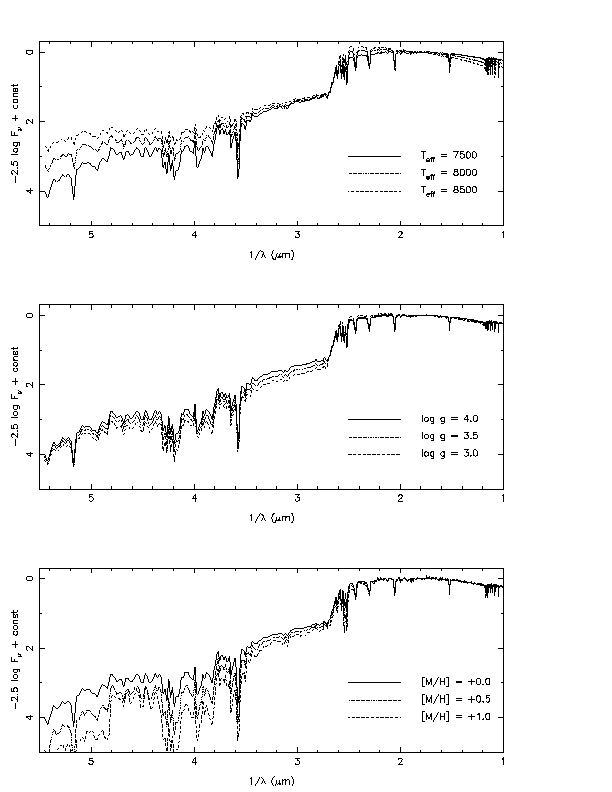
Figure 2: The sensitivity of flux distributions to Teff, log g
and [M/H]. The solid line is for a model with Teff = 7500, log g = 4.0
and [M/H] = 0.0. The dotted and dashed lines indicate models
with one of the parameters adjusted, as indicated. All fluxes have been
normalized to zero at 5556Å.
Optical spectrophotometry is generally placed on the Hayes & Latham
(1975) absolute flux scale, with has an overall uncertainty of around
±0.02 mag. As well as the secondary standards listed by Taylor
(1984), there are some very useful catalogues, including of Breger
(1975), Ardeberg & Virdefors (1980) and Adelman et al. (1989).
Optical spectrophotometry can be supplemented by the use of satellite
observations. Ultraviolet fluxes can be obtained, for example, from the
S2/68 catalogues (Jamar et al., 1976; Macau-Hercot et al., 1978) and low
resolution IUE spectra. This can improve the sensitivity of the fits to
chemical composition.
For normal stars spectrophotometric flux fitting allows for a good
determination of Teff (Morossi & Malagnini, 1985). However,
interstellar reddening must be allowed for, since it can have a
significant effect on the observed flux distribution and any derived
Teff. Unfortunately, log g does not appear to be reliably
determined from spectrophotometry. Malagnini, Faraggiana & Morossi
(1983) for that for B stars log g was poorly determined from continuum
spectrophotometry. Smalley (1992) found that even by increasing the metal
abundance in the models used to fit the spectrophotometry of Am stars,
the log g is still too low when compared to that obtained from
photometry.
Clearly, further higher-quality spectrophotometry is required, so that
spectrophotometric flux fitting can reach its true potential as an
atmospheric parameter diagnostic.
Hydrogen line profiles
The Balmer lines provide an excellent Teff diagnostic for stars
cooler than about 8000 K due to their virtually nil gravity dependence
(Gray, 1992). Theoretical profiles can be generated with Peterson's
BALMER program, which uses the stark broadening tables of Vidal,
Cooper & Smith (1973). By fitting these theoretical profiles to
observations, we can determine Teff. For stars hotter than 8000 K,
however, the profiles are sensitive to both temperature and gravity. For
these stars, the Balmer lines can be used to obtain values of log
g, provided that the Teff can be determined from a
different method.
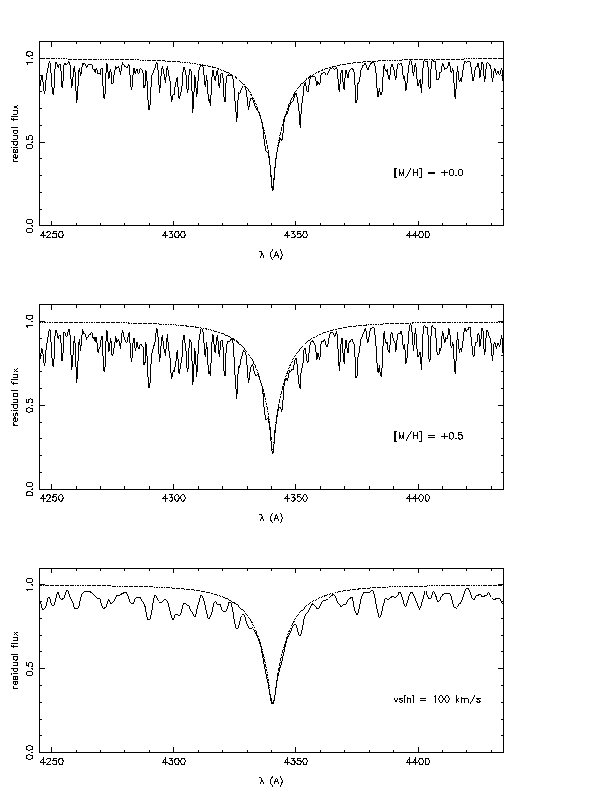
Figure 3: The effect of increasing [M/H] and v sin i on the spectrum
around Hβ. These are synthetic spectra with Teff = 7500
and log g = 4.0 and a simulated resolution of around 0.4Å. The true
Hβ profile is shown as the dotted line.
While the hydrogen lines are relatively free from absorption lines in
most B-type stars, the same cannot be said of stars later than mid
A-type. Fitting is hampered by the numerous metal lines in the spectra of
these stars, ironically just as the hydrogen lines become insensitive to
log g! Nevertheless, by careful reductions and analysis, observations
of Balmer lines can still be used to determine Teff.
Normalization of the observations is critical. Naturally, the shape of
the Balmer line must be preserved (Smith & van't Veer, 1987). A useful
check is to observe Vega or Sirius and compare the reduced spectrum with
those given by Peterson (1969). While it is very difficult – if not
impossible – to use échelle spectra, medium-resolution spectra can
be used. We have to allow for the effects of blending of metal lines and
the effects of rotation. Rotation is potentially a more difficult
problem, since by increasing resolution we can reduce the effects of
blending, but not that caused by rotational smearing.
Figure 3 shows the effects of increasing [M/H] and v sin
i on the apparent continuum level. By reference to synthetic spectra the
location of the true continuum level can be established.
An alternative approach to fitting hydrogen lines has been used by van't
Veer, Cayrel & Coupry (1991). They use the ratio of a star's profile
with respect to that of Procyon. This procedure cancels some instrumental
effects and reduces the uncertainties in continuum location. Of course,
the Teff of Procyon has to be assumed, but it does have a
fundamental value.
Overall, hydrogen lines give very good values of Teff for A
and F stars, with internal errors of the order of 100 K or less. But,
naturally, the actual value of Teff is model dependant.
Infrared Flux Method
The IRFM, developed by Blackwell & Shallis (1977) and Blackwell, Petford
& Shallis (1980), can be used to determine Teff. The method
relies on the fact that the stellar surface flux at an infrared
wavelength is relatively insensitive to temperature. The method is almost
model independent, with only the infrared flux at the stellar surface
requiring the use of models (Blackwell & Lynas-Gray, 1994; Mégessier,
1994).
The method requires a complete flux distribution in order to obtain the
total integrated (bolometric) stellar flux. In practice, however, all of
the flux is not observable, especially in the far-ultraviolet. But, this
is only a serious problem in the hotter stars. Here model atmospheres
have to be used to insert the missing flux, in order to obtain the total
integrated flux. Accurate infrared fluxes are, of course, essential for
this method to produce reliable results. Several direct and indirect flux
calibrations have been performed (Hayes, 1979; Dreiling & Bell, 1980;
Wamsteker, 1981), with the absolute flux measurements of Vega by Mountain
et al. (1985) being particularly important. Gezari, Schmitz & Mead
(1987) have produced a comprehensive catalogue of infrared flux
measurements, including fluxes from the IRAS satellite. Blackwell et al.
(1990) gave a good discussion on the IRFM.
The method is, of course, sensitive to any cool companions. The effect of
the companion is to lower the Teff derived for the primary.
A modified method was proposed and discussed by Smalley (1992, 1993b).
This method relies on the relative radii of the two components in the
binary system. The effect of allowing for the companion can be dramatic;
the Teff determined for the primary can be increased by 200 K or
more.
Given good spectrophotometry, the IRFM should give the `best' fundamental
estimate of Teff, short of a `true' fundamental value. It ought
to be possible to obtain temperatures to an accuracy of 1% or better
(Blackwell et al., 1990). Provided that we do not have a companion star!
The Teff–log g diagram
The results from the four methods discussed above can be used to
construct a Teff–log g diagram (sometimes called a Kiel
Diagram). This is a great visualization tool, since it allows you to view
the relative positions of solutions from the different methods. Using
such a diagram it is easy to see how varying various other parameters,
such as [M/H], affects the relative positions of the various solutions.
Figure 4 shows a Teff–log g diagram for the
classical Am star 63 Tau. The solar abundance results are obviously
discordant. By increasing the abundance to [M/H] = +0.5 and introducing a
cool companion (5000 K), a much better agreement can be obtained.
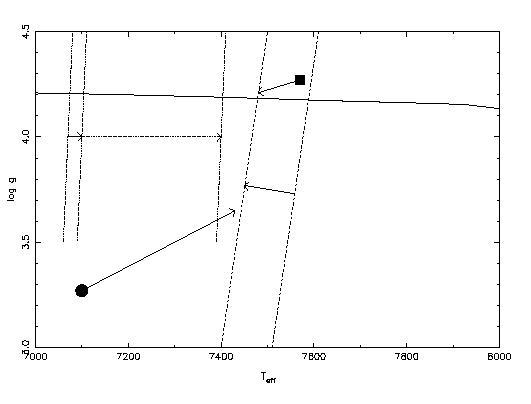
Figure 4: A Teff–log g diagram for the Am star 63 Tau. The results
from the four methods are shown as follows: the filled square is from the
Moon & Dworetsky (1985) uvbyβ girds, the filled circle is from
spectrophotometry, the dashed line that from fitting Hβ profiles
and the dotted line the IRFM result. Photometry and Balmer lines agree
very well, but are significantly hotter than the results from
Spectrophotometry and the IRFM. The solid arrows indicate the effect of
using [M/H] = +0.5 models. Now spectrophotometry is in good agreement with
photometry and Balmer line, but the IRFM is still significantly lower.
However, by introducing a cool companion (5000 K) the IRFM can be brought
into agreement with the other methods (dotted arrow). The solid line is
the Hyades isochrone, based on the evolutionary calculations of Schaller
et al. (1992). Note that the log g from spectrophotometry is
significantly lower than that from photometry.
Fundamental Stars
A fundamental star is one in which its atmospheric parameters (or at
least one) has been obtained without using model atmospheres. These are
the ``pins'' by which the models can held in place.
Fundamental values of Teff can be obtained from angular
diameters and spectrophotometry (see Code et al., 1976). Angular diameters
can be measured directly using interferometry (Hanbury Brown et al., 1974;
McAlister & Hartkopf, 1988) or from observations of lunar occultations
(e.g. Ridgway et al., 1982). The spectrophotometric requirement is the
same as in the IRFM, in that a complete flux distribution is required.
Often, especially in hot stars, model atmosphere fluxes have to be used
to add in the contribution from unobserved far-ultraviolet flux (Code et
al., 1976).
A fundamental value of log g can be obtained for a star which has a
known mass and radius. Binary systems are the main source of fundamental
log g values, even then we are restricted to detached double-lined
eclipsing binary systems. Furthermore, for these stars to be useful in
testing or calibrating model atmospheres, the two stars must be
essentially identical. For a full discussion on binary systems the
reviews of Popper (1980) and Andersen (1991) should be consulted.
Of all the fundamental stars, only Sirius and Procyon have truly
fundamental values of both Teff and log g. This
prompted Smalley & Dworetsky (1995) to review the lists of fundamental
stars. They examined the fundamental temperatures obtained by Code et al.
(1976) and concluded that modern data produced no significant
differences. Additionally, they extended the list of stars with
fundamental values of both Teff and log g, by
obtaining fundamental temperatures for some binary systems. Angular
diameters were indirectly inferred from the stellar radii and distances
(from the parallax catalogue of van Altena et al., 1991). The extra step
involved in obtaining angular diameters and the lower quality of the
spectrophotometry meant that the uncertainties were much larger. Indeed,
there is much scope for improvement, by using better quality flux
measurements and higher accuracy distances.
Chemical composition cannot be obtained in a fundamental manner. We must
use perform model-dependent abundance analyses relative to some normal or
standard. The only true standard is the Sun (Anders & Grevesse, 1989).
However, in order to obtain a good Teff and log g, we only
need to have a good determination of the mean metal content. A good
estimate of [M/H] can be obtained from photometry, for example. Once we
have reliable atmospheric parameters, a detailed abundance analysis ought
to give us a reliable composition. This is provided we have a good
microturbulence and allow for the effects on the apparent continuum level
due to blending and rotational smearing.
Overall the accuracy of the fundamental stars is lower than the internal
errors of the model-dependent methods for determining atmospheric
parameters. Hence, we need to significantly improve the fundamental
stars, especially to improve the Teff scale. Also, we need more
chemically peculiar stars with fundamental parameters, in order to test
the models of such stars.
Conclusion
As we have seen, the four most widely used methods of determining
Teff and log g can be used together to obtain a self-consistent
solution. This is provided that the effects of [M/H], binary companions,
etc. are taken into account.
Over recent years there have been considerable improvements in the area
of model atmospheres. Two of the most significant have been the improved
opacity in model fluxes (Kurucz, 1991) and improvements in the treatment
of convection. The work presented by Kupka at this workshop is
particularly interesting. In fact, initial tests by myself and Nathan
Rogers during this workshop indicate that these model colours agree very
well with those of the fundamental stars. We can now be hopeful that
model atmospheres are now free from large systematic errors.
In order to thoroughly test the results from model atmosphere
calculations, we need improved atmospheric parameters for the fundamental
stars. The ``pins'' need to be placed with an accuracy of 1% or better.
The current best is only 2%, with most no better than 4%. More
importantly, we do not have enough chemically peculiar star with
fundamental parameters. These are needed to ensure that the models of
such stars are reliable. After all, it is the systematics that cause the
greatest uncertainties; not the exact values of the atmospheric
parameters.
References
Adelman, S.J. & Gulliver, A.F., 1990, ApJ, 348, 712
Adelman, S.J., Pyper, D.M., Shore, S.N., White, R.E. & Warren, W.H., 1989, A&AS, 81, 221
Anders, E. & Grevesse, N., 1989, Geochim. Cosmochim. Acta, 53, 197
Andersen, J,. 1991, A&A Rev, 3, 91
Ardeberg, A. & Virdefors, B., 1980, A&AS, 40, 307
Berthet, S., 1990, A&A, 236, 440
Blackwell, D.E. & Lynas-Gray, A.E., 1994, A&A, 282, 899
Blackwell, D.E. & Shallis, M.J., 1977, MNRAS, 180, 177
Blackwell, D.E., Petford, A.D. & Shallis, M.J., 1980, A&A, 82, 249
Blackwell, D.E., Petford, A.D., Arribas, S., Haddock, D.J. & Selby, M.J., 1990, A&A, 232, 396
Breger, M., 1976, ApJS, 32, 7
Buser, R. & Kurucz, R.L., 1978, A&A, 70, 555
Buser, R. & Kurucz, R.L., 1992, A&A, 264, 557
Castelli, F., 1991, A&A, 251, 106
Code, A.D., Davis, J., Bless, R.C. & Hanbury Brown, R., 1976, ApJ, 203, 417
Crawford, D.L., 1975, AJ, 80, 955
Crawford, D.L. & Barnes, J.V., 1970, AJ, 75, 978
Crawford, D.L. & Mander, J., 1966, AJ, 71, 114
Crawford, D.L. & Perry, C.L., 1976, PASP, 88, 454
Dreiling, L.A. & Bell, R.A., 1980, ApJ, 241, 736
Dworetsky, M.M. & Moon, T.T., 1986, MNRAS, 220, 787
Gezari, D.Y., Schmitz, M. & Mead, J.M., 1987, Catalog of infrared observations, NASA Ref. Publ., 1196
Gray, D.F., 1992, The observation and analysis of stellar photospheres, Cambridge University Press, p. 348
Gulliver, A.F., Hill, G. & Adelman, S.J., 1994, ApJ, 429, L81
Hanbury Brown, R., Davis, J. & Allen, L.R., 1974, MNRAS, 167, 121
Hauck, B. & Mermilliod, M., 1990, A&AS, 86, 107
Hayes, D.S., 1979, in Problems of Calibration of Multicolor Photometric Systems, Philip, A.G.D., Dudley Obs. Rept. 14, p. 297
Hayes, D.S. & Latham, D.W., 1975, ApJ, 197, 593
Jamar, C., Macau-Hercot, D., Monfils, A., Thompson, G.I., Houziaux, L. & Wilson, R., 1976, Ultraviolet bright-star spectrophotometric catalogue, ESA SR-27
Johnson, H.L., 1958, Lowell Obs. Bull., 90
Johnson, H.L. & Morgan, W.W., 1953, ApJ, 117, 313
Kobi, D. & North, P., 1990, A&AS, 85, 999
Kurucz, R.L., 1979, ApJS, 40, 1
Kurucz, R.L., 1991, in Precision Photometry: Astrophysics of the Galaxy, Philip, A.G.D., Upgren, A.R. & Janes, K.A., L. Davis Press, Schenectady, p. 27
Lane, M.C. & Lester, J.B., 1984, ApJ, 281, 723
Lester, J.B., Gray, R.O. & Kurucz, R.L., 1986, ApJS, 61, 509
Macau-Hercot, D., Jamar, C., Monfils, A., Thompson, G.I., Houziaux, L. & Wilson, R., 1978, Supplement to the Ultraviolet bright-star spectrophotometric catalogue, ESA SR-28
Malagnini, M.L., Faraggiana, R. & Morossi, C., 1983, A&A, 128, 375
Malagnini, M.L., Morossi, C., Rossi, L. & Kurucz, R.L., 1986, A&A, 162, 140
McAlister, H.A. & Hartkopf, W.I., 1988, Second Catalog of Interferometric Measurements of Binary Stars, CHARA Contributions, 2
Mégessier, C., 1994, A&A, 289, 202
Moon, T.T., 1985, Comm. Univ. London Obs., 78
Moon, T.T. & Dworetsky, M.M., 1985, MNRAS, 217, 305
Morossi, C. & Malagnini, M.L., 1985, A&AS, 60, 365
Mountain, C.M., Leggett, S.K., Selby, M.J., Blackwell, D.E. & Petford, A.D., 1985, A&A, 151, 399
Napiwotzki, R., Schönberner, D. & Wenske, V., 1993, A&A, 268, 653
Nissen, P.E., 1988, A&A, 199, 146
North, P. & Hauck, B., 1979, in Problems of Calibration of Multicolor Photometric Systems, Philip, A.G.D., Dudley Obs. Rept. 14, p. 183
North, P. & Nicolet, B., 1990, A&A, 228, 78
Olsen, E.H., 1984, A&AS, 57, 443
Peterson, D.M., 1969, SAO Sp. Rept., 293
Popper, D.M., 1980, Ann. Rev. A&A, 18, 115
Relyea, L.J. & Kurucz, R.L., 1978, ApJS, 37, 45
Ridgway, S.T., Jacoby, G.H., Joyce, R.R., Siegel, M.J. & Wells, D.C., 1982, AJ, 87, 680
Schaller, G., Schaerer, D., Meynet, G. & Maeder, A., 1992, A&AS, 96, 269
Smalley, B. & Dworetsky, M.M., 1993, A&A, 271, 515
Smalley, B. & Dworetsky, M.M., 1994, in IAU XXIInd General Assembly 1994 Posters Abstracts, van Woerden, H., Twin Press, 229
Smalley, B. & Dworetsky, M.M., 1995, A&A, 293, 446
Smalley, B., 1992, PhD thesis, University of London
Smalley, B., 1993a, A&A, 274, 391
Smalley, B., 1993b, MNRAS, 265, 1035
Smith, K.C. & van't Veer, C., 1988 in Elemental Abundance Analyses, Adelman, S.J. & Lanz, T., Institut d'Astronomie de l'Universite de Lausanne, p. 133
Strömgren, B., 1963, QJRAS, 4, 8
Strömgren, B., 1966, Ann. Rev. A&A, 4, 433
Taylor, B.J., 1984, ApJS, 54, 259
van Altena, W.F., Truen-Liang Lee, J. & Hoffleit, D., 1991, Yale University Observatory, New Haven
van't Veer, C., Cayrel, R. & Coupry, M.F., 1991, in Evolution of Stars: The Photospheric Abundance Connection, Poster presented at IAU Symp. 145, Michaud, G., Tutukov, A. & Bergevin, M., University of Montreal, p. 49
Vidal, C.R., Cooper, J. & Smith, E.W., 1973, ApJS, 25, 37
Wamsteker, W., 1981, A&A, 97, 329