An observational test of a new convection theory
B. Smalley (1), F. Kupka (2), N. Rogers (3)
(1) Department of Physics, Keele University, Staffordshire ST5 5BG, UK
(2) Institute for Astronomy, University of Vienna, Türkenschanzstr. 17, A-1180 Vienna, Austria
(3) Department of Astronomy, University of Southern California, Los Angeles, CA 90089-1342, USA
Introduction
The gross properties of a star, such as broad-band colours and flux
distributions are significantly influenced by the microscopic effects of
convection in stars later than mid A-type. Consequently, our treatment of
convection in stellar atmosphere models can significantly alter our
interpretation of observed phenomena. While the Kurucz (1979)
ATLAS6 model atmospheres have generally had considerable success in
the interpretation of stellar fluxes and spectra, the models for A and F
stars have always been somewhat discrepant. Relyea & Kurucz (1978)
discussed several possible reasons for discrepancies between theoretical
and observational Strömgren uvby colours, including the effects of
missing opacity and convection.
Several attempts have been made to improve the models for stars cooler
with Teff < 8500 K. For example, Lester, Lane & Kurucz (1982)
studied the effect of using a modified mixing-length theory and found
that the effects are readily observable. Others have taken the model
Strömgren uvby colours and adjusted them until they agreed better
with colours of stars with known Teff and log g (Moon &
Dworetsky 1985, Lester, Gray & Kurucz 1986, see also Smalley 1996). The
latest generation of Kurucz (1991, 1993) ATLAS9 models contain
much-improved line opacities and ought to give better agreement with
observations. Indeed they do, but there are still some discrepancies.
Could these be due to the treatment of convection in the models?
Turbulent Convection
The Kurucz ATLAS models, in there various generations, have
always used some form of mixing-length theory for the treatment of
convection in the stellar atmosphere. The latest ATLAS9 models
even include an approximate treatment of convective overshooting.
Recently, there have been advances in the theory of turbulent convection
(Canuto & Mazzitelli 1991, 1992). This theory, referred to as the CM
model, has been incorporated into the ATLAS9 code (Kupka 1996,
Canuto & Kupka 1996).
Here we compare the effects of different treatments of convection on the
Strömgren uvby colours for models with Teff < 8500 K. We
discuss the predicted colours of three sets of solar-composition Kurucz
(1993) ATLAS9 models:
- Standard
ATLAS9 models using mixing-length theory with convective overshooting. The
original models were in error due to a bug in the code, this has now been
fixed (Castelli & Kurucz 1995).
- Standard
ATLAS9 models using mixing-length theory, but
without convective overshooting.
- Modified
ATLAS9 models using the CM model of turbulent convection.
The model colours are compared to with those of the fundamental stars
listed in Smalley & Dworetsky (1995). The preliminary results are now
presented.
Results
The results of the comparison of the various model colours with those of
the fundamental stars are shown in Figure 1. The CM models give
Teff and log g that are in very good agreement with the fundamental
stars. The models without overshooting are in less of an agreement, while
the standard ATLAS9 colours with overshooting are clearly
discrepant, especially for cooler stars.
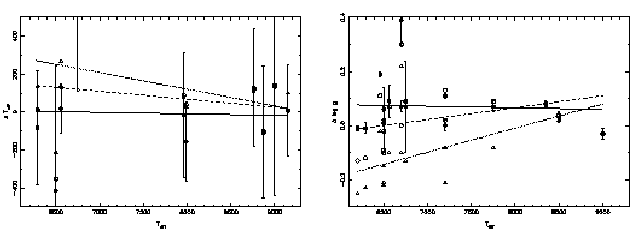
Figure 1: Comparison of different grids with fundamental stars. In
all cases the differences are model minus fundamental values. The lines
are weighted least squares fits. The filled circles and solid line are
for the CM models, the open circles and dashed line are for mixing-length
models without overshooting, and the open triangles and dot-dashed line
are for mixing-length model with overshooting. The errorbars are the
uncertainties on the fundamental values, and for clarity are given only
for the CM data points.
Conclusion
The results of this initial comparison indicate that model atmospheres
using the Canuto & Mazzitelli (1991, 1992) turbulent convection theory
are very successful in recovering the colours of the fundamental stars.
Further work is in process to confirm these findings, but the initial
results are very encouraging. Full results will be presented in Smalley,
Kupka & Rogers (1996).
References
Canuto V.M., Kupka F., 1996, in preparation
Canuto V.M., Mazzitelli I., 1991, ApJ, 370, 295
Canuto V.M., Mazzitelli I., 1992, ApJ, 389, 724
Castelli F., Kurucz R.L., 1995, private communication
Kupka F., 1996, in Model Atmospheres and Spectrum Synthesis, Adelman S.J., Weise W.W., Kupka F., eds., ASP Conf Series, (in preparation)
Kurucz R.L., 1979, ApJS, 40, 1
Kurucz R.L., 1991, in Precision Photometry: Astrophysics of the Galaxy,
Philip A.G.D., Upgren A.R., Janes K.A., eds., L. Davis Press, Schenectady, p. 27
Kurucz R.L., 1993, Kurucz CD-ROM 13: ATLAS9, SAO, Cambridge, USA.
Lester J.B., Gray R.O., Kurucz R.L., 1986, ApJS, 61, 509
Moon T.T., Dworetsky M.M., 1985, MNRAS, 217, 305
Relyea L.J., Kurucz R.L., 1978, ApJS, 37, 45
Smalley B., 1996, in Model Atmospheres and Spectrum Synthesis, Adelman S.J., Weise W.W., Kupka F., eds., ASP Conf Series, (in preparation)
Smalley B., Dworetsky M.M., 1995, A&A, 293, 446
Smalley B., Kupka F., Rogers N., 1996, in preparation.