|
 
|
THE
BLOB


The remarkable discovery of a dust cloud next to a luminous hot star
|
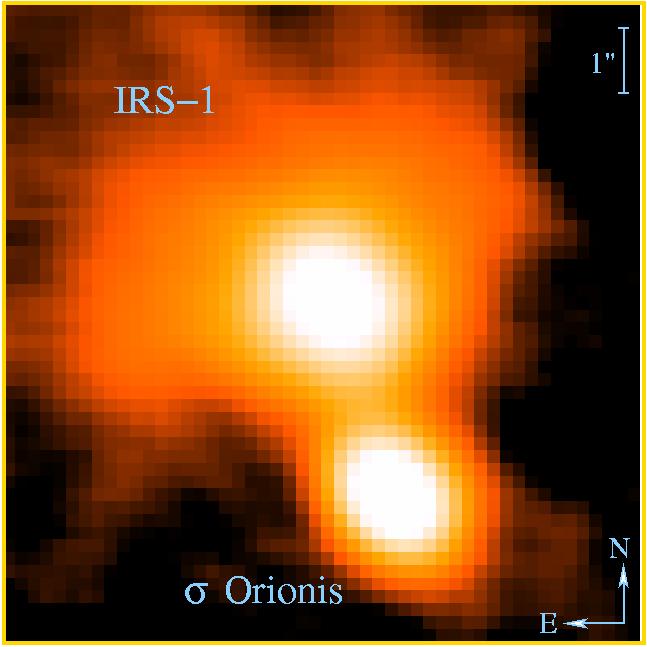
In December 2002, we discovered an extended object only a few arcseconds away
from the naked-eye star sigma Orionis. The new object, dubbed sigma Orionis
IRS-1, shines brightly in the infrared. Its spectral energy distribution
("colours") and a strong spectral emission feature around a wavelength of 10
micron due to silicate grains imply that it is a dust cloud. The cloud is
spatially resolved: it has a fan shape, pointing away from the hot star sigma
Orionis. With an estimated age of about 5 million years, the stars belonging
to the sigma Orionis cluster have only recently formed. Yet it is surprising
how a dust cloud could have survived so long so near to sigma Orionis. It is
not yet clear whether the dust cloud harbours an infant star, or whether it is
a "leftover" from the molecular cloud in which sigma Orionis formed.
Drake, in 1990, actually discovered this object at radio wavelengths but at
the time attributed the difference in position with sigma Orionis to
astrometric inaccuracies of the latter. The radio source is located closer to
IRS-1 but at the side facing sigma Orionis, suggesting it is the part of the
dust cloud which is directly irradiated and ionized by sigma Orionis. This
confirms the physical interaction between the two objects and their close
proximity to one another.
The observations were performed with the TIMMI-2 imager/spectrograph at the
3.6 metre telescope at the European Southern Observatory, La Silla, Chile, and
have been published as a
Letter to Astronomy and Astrophysics.